
Oaxaca City From Puerto Escondido: The Drive Every Owner Should Make
There is no shortage of things to do on this coast. But every couple of months I get in the car, drive inland through the Sierra Madre del Sur, and spend a few days in Oaxaca City. It is one of my favourite getaways anywhere in Mexico, and I have never once come back from it disappointed.
I have just returned from another trip up there, and I wanted to write it down properly. Because when people ask me what it is actually like to live in Puerto Escondido — not the two-week holiday version, the real version — this is a large part of the answer.
The New Highway Changed Everything
For decades, getting from the Oaxacan coast to Oaxaca City meant Highway 131 through Sola de Vega: roughly six and a half hours of switchbacks through the mountains, and a reliable way to lose a day in each direction. Plenty of people simply did not bother.
In February 2024 that changed. The Barranca Larga–Ventanilla highway opened — about 104 kilometres of tunnels, bridges and cuttings driven straight through the Sierra Madre del Sur — and the drive collapsed to roughly two and a half hours. From my door at Vivo Resorts it is a little over three, including the run up the coast road. Tolls are around 234 pesos each way, and you will want cash for the booths.
That one piece of infrastructure is among the quieter reasons Puerto Escondido has changed as fast as it has. A UNESCO World Heritage city, a world-class food scene and two thousand years of history are now a comfortable morning's drive from the beach. You can leave after breakfast and be eating lunch in a courtyard in the Centro Histórico.
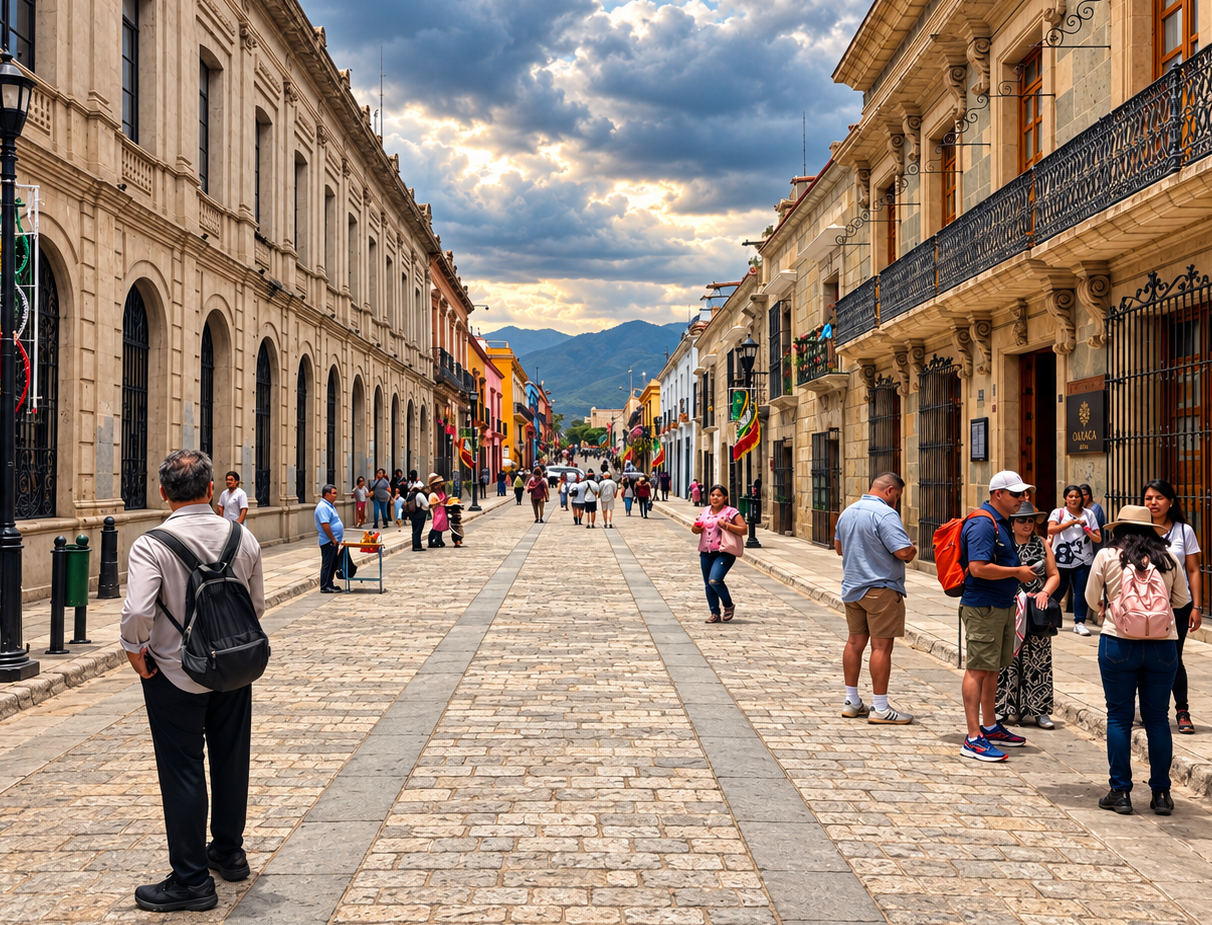
The Centro Histórico, Oaxaca de Juárez — a UNESCO World Heritage site since 1987.
One of the Most Beautiful Cities in Mexico
Oaxaca de Juárez has been a UNESCO World Heritage Site since 1987, listed together with Monte Albán, and it earns the designation. Cobblestone streets. Low colonial buildings in deep terracotta, ochre and cochineal red. Courtyards you catch glimpses of through open doorways. Green mountains rising behind every rooftop. In spring the jacarandas bloom and the whole city turns purple.
The Templo de Santo Domingo de Guzmán is worth the trip on its own. From the street it is plain, heavy stone, almost severe. Step inside and the entire ceiling is gilded — thousands of figures picked out in gold leaf, a family tree of the Guzmán line spreading across the vault above the door. Next to it, the Museo de las Culturas de Oaxaca holds the gold and jade recovered from Tomb 7 at Monte Albán, which is as fine a collection of pre-Hispanic work as you will see anywhere.
And everything is walkable. Park the car when you arrive and you will not need it again until you leave. The Zócalo, the Andador Macédonio Alcalá, the markets, the mezcal bars, the galleries — all of it inside twenty minutes on foot. That is rarer than it sounds.
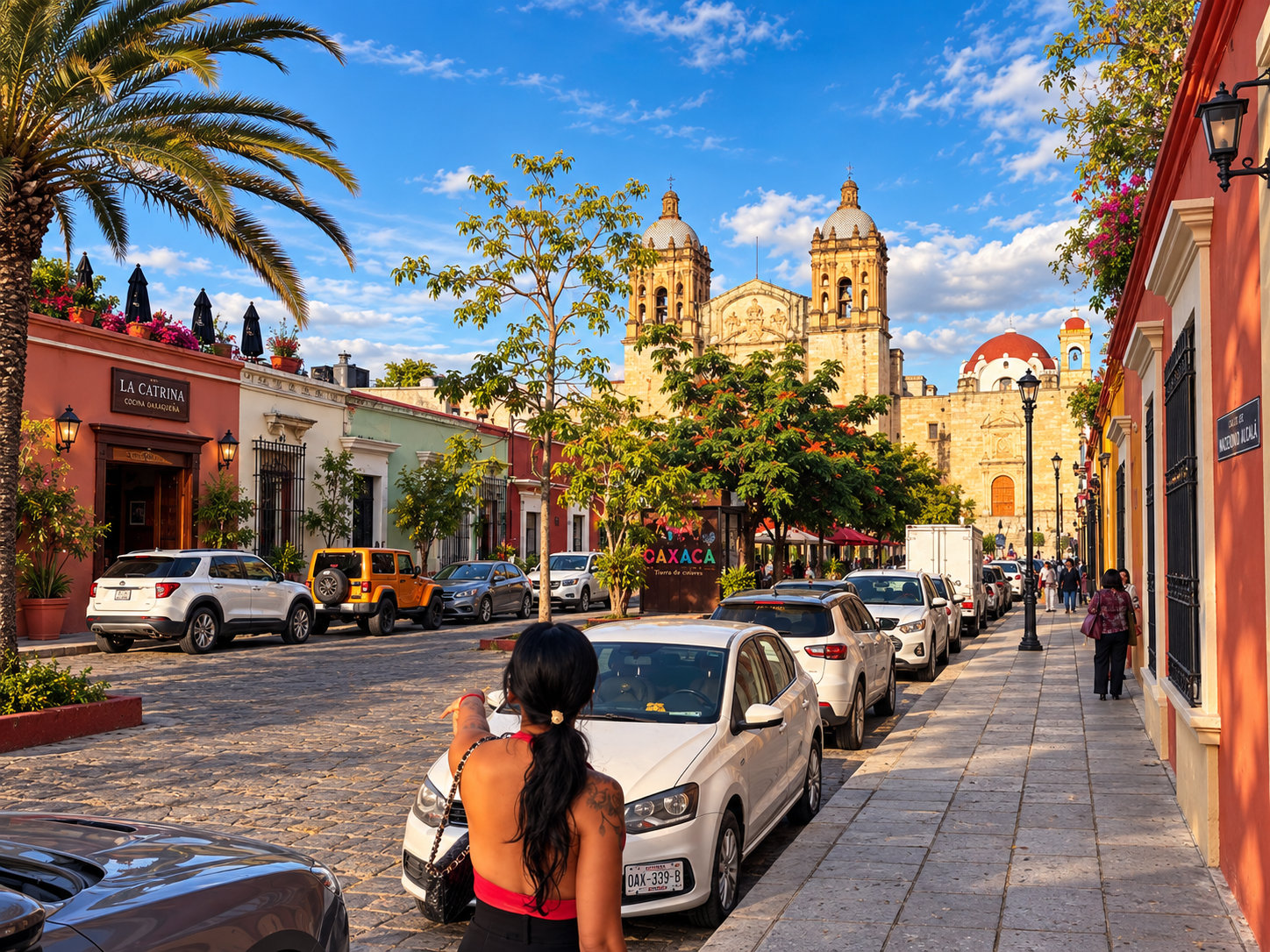
The Templo de Santo Domingo de Guzmán — plain stone from the street, and a ceiling of gold leaf inside.
The Food Alone Is Worth the Drive
Oaxaca is widely considered the culinary capital of Mexico, and the claim holds up under pressure. There are seven distinct moles here — from the deep, near-black mole negro to the bright amarillo, the smoky coloradito, the herbaceous verde — and each one takes hours and dozens of ingredients. Chiles grow in these valleys that grow nowhere else on earth: chilhuacle negro, pasilla mixe, chile de agua. Take them out and the dish simply cannot be made.
Eat a tlayuda at Mercado 20 de Noviembre — a huge crisp tortilla loaded with quesillo, asiento and tasajo, eaten standing up for a few dollars. Walk through the Mercado Benito Juárez for chapulines, chocolate ground with almonds and cinnamon, and string cheese pulled into ribbons in front of you. Then have dinner that evening at Casa Oaxaca or Criollo, where the same ingredients turn up on a tasting menu with a wine list.
Both ends of that day are excellent. Neither feels like a compromise. That is the thing about eating in Oaxaca: there is no gap between the street food and the fine dining, only a difference in how it is plated.
Mezcal: Forty Agaves, Not One
If your only reference point is tequila, a proper mezcal tasting will change your mind entirely. Tequila comes from a single agave, blue weber. Mezcal is made from more than forty, and each one tastes different.
Espadín is the everyday pour, smoky and a little sweet, and it is what most people start with. Tobalá is wild, floral and aromatic, made in tiny quantities because it has to be found rather than farmed. Tepeztate grows high in the hills and takes twenty-five years or more to mature, which is why a bottle costs what it costs. Madrecuixe is lean and mineral, almost vegetal.
Places like In Situ and Mezcaloteca will walk you through it properly, bottle by bottle, with water and orange rather than a lime and salt routine. Most of what they pour comes from families in villages hours outside the city who have been making it in clay pots and copper stills the same way for generations. You are not drinking a brand. You are drinking a place and a person.
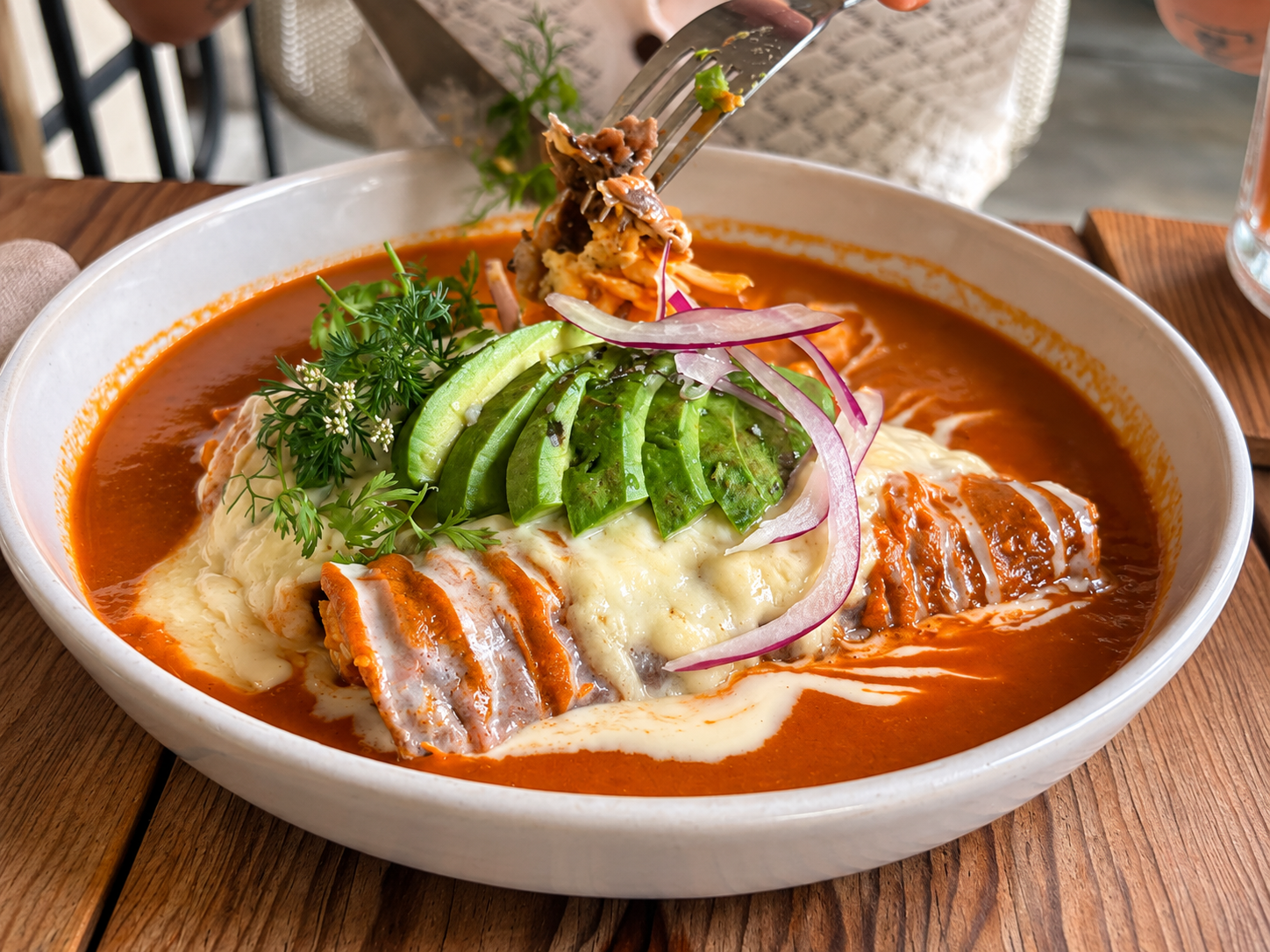
Seven moles, dozens of ingredients, and chiles that grow nowhere else on earth.
Monte Albán and the Valleys Around the City
Twenty minutes outside the city, Monte Albán sits on top of a mountain the Zapotecs flattened by hand more than two thousand years ago. Stone pyramids, a ball court and a vast open plaza, with the three arms of the valley spread out below you in every direction. The Zapotec capital flourished for thirteen centuries, from roughly 500 BC to AD 850, making it one of the first true cities in the Americas. Stand up there for ten minutes and it is not hard to understand why they chose the spot.
The valleys around it are just as good, and most of it can be done in a single day:
Hierve el Agua — mineral springs that have left what look like frozen waterfalls spilling down the side of a cliff, with pools at the top you can sit in.
Santa María del Tule — home to a Montezuma cypress with the widest trunk of any tree on the planet. It is roughly two thousand years old and genuinely difficult to photograph.
Teotitlán del Valle — the weaving village, where families still work on pedal looms and dye wool with cochineal, indigo and marigold exactly as they have for centuries.
Mitla — Zapotec ruins covered in geometric stone mosaic, cut and fitted without mortar, unlike anything else in Mexico.
San Bartolo Coyotepec and San Martín Tilcajete — black pottery and carved alebrijes, made in workshops you can walk straight into.
Día de Muertos Is in a Class of Its Own
If you can time a visit for the end of October, Oaxaca is one of the great places in the world to see Día de Muertos. Marigolds by the truckload, sand paintings across the Zócalo, comparsas winding through the streets at midnight, and families sitting with their dead in the cemeteries at Xoxocotlán and Atzompa with candles and bread and a bottle of mezcal.
It is not a spectacle staged for visitors. It is a city doing something it has always done, and being welcome to stand at the edge of it is a privilege. Book accommodation months ahead — everyone else has worked this out too.
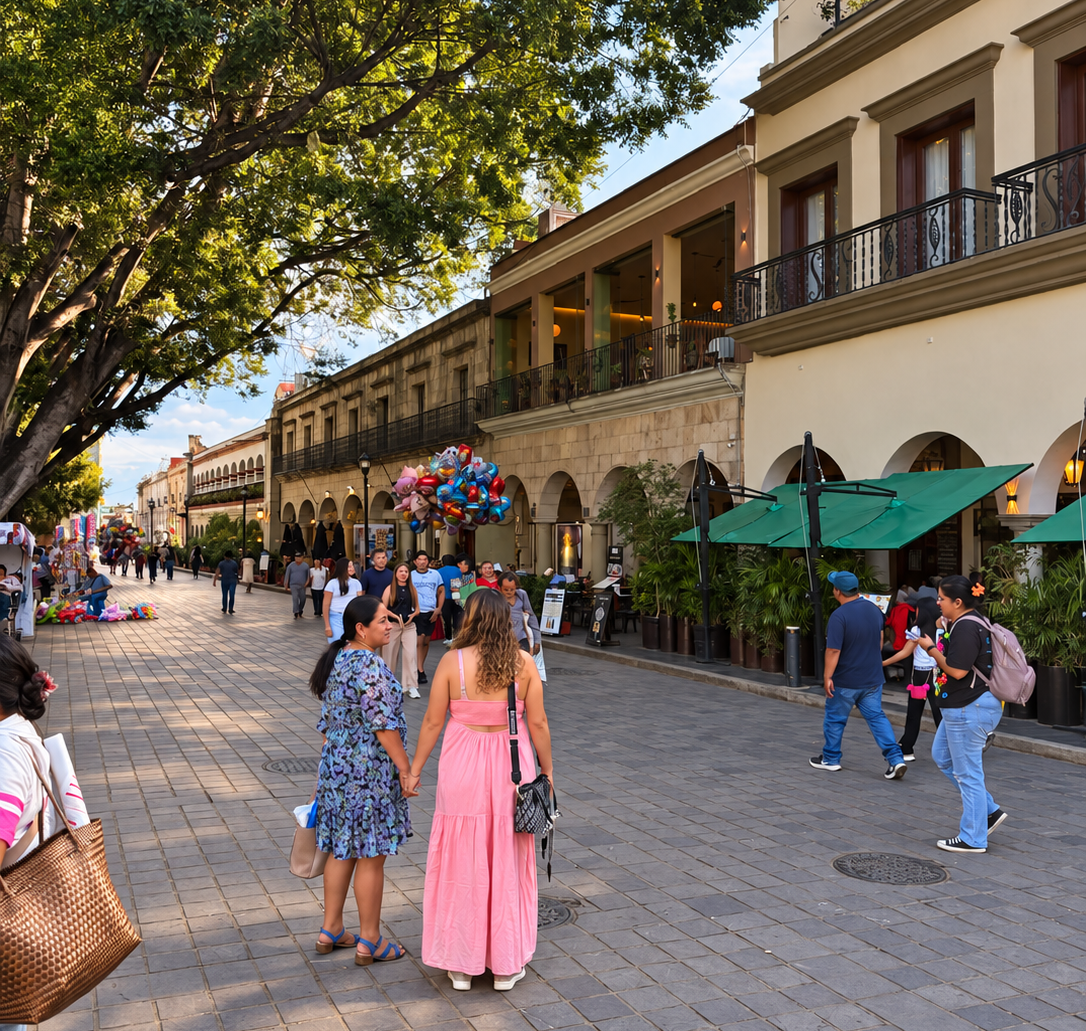
Everything is walkable. Park the car when you arrive and you will not need it again until you leave.
What This Has to Do With Buying in Puerto Escondido
A lot of beach destinations are only a beach. They are lovely for two weeks, and then you have seen them. The restaurants repeat, the drive repeats, and by year three people quietly start looking somewhere else.
Puerto Escondido is not that, and Oaxaca City is the clearest proof of it. Owning here puts one of the great cultural capitals of the Americas within an easy morning's drive. You can be eating mole in a courtyard in the Centro Histórico by lunchtime and back on your own balcony watching the sun go down over the Pacific the following evening. Add the surf, the lagoons at Manialtepec and Chacahua, the coffee farms in the Sierra Sur and the turtle beaches south of town, and the list of things to do stops being a list and starts being a life.
That combination — world-class coast, world-class city, two and a half hours apart — is rare. It is a large part of why the people who buy here end up staying far longer than they planned, and why so many of them buy a second time.
Come Along on the Trip
I filmed a fair bit while I was up there — the city, the markets, the food and the mezcal. It is a short montage, and it will give you a better sense of the place than anything I can write. Watch the Oaxaca City video here, and have a look at the rest of the channel while you are there.
Frequently Asked Questions
How far is Oaxaca City from Puerto Escondido?
Roughly two and a half hours by car on the Barranca Larga–Ventanilla highway, which opened in February 2024. Allow a little over three hours door to door from the Vivo Resorts area, including the coast road. Before the new highway the same trip took about six and a half hours on Highway 131.
Is the drive to Oaxaca City difficult?
No. It is a modern toll highway with tunnels and bridges rather than the old mountain switchbacks. Drive it in daylight, keep about 234 pesos in cash per direction for the toll booths, and fill the tank before you leave the coast.
Can you fly between Puerto Escondido and Oaxaca City?
Yes. There are short scheduled flights of around half an hour between Puerto Escondido (PXM) and Oaxaca City (OAX). Most people drive now that the highway is open, but the flight is a good option in the rainy season or if you are short on time.
When is the best time to visit Oaxaca City?
Late October and early November for Día de Muertos, and March to May for the jacarandas and dry, warm days. July brings the Guelaguetza festival. The city sits at around 1,550 metres, so it is noticeably cooler than the coast year round — bring a jacket for the evenings.
How many days do you need in Oaxaca City?
Three nights is the sweet spot: one day for the Centro Histórico and Santo Domingo, one for Monte Albán and the valley villages, and one for the markets, the mezcalerías and a proper dinner. Four if you want Hierve el Agua without rushing.
Do you need a car in Oaxaca City?
Not in the city itself — the historic centre is entirely walkable. A car or a driver is useful for Monte Albán, Hierve el Agua and the weaving villages, though there are good guided day tours for all of them.
Come and See the Coast for Yourself
I host a Discovery Tour where you spend a week on the coast, see the properties in person, meet the people who have already made the move, and get every question answered without a sales pitch attached. If you want to add a couple of days in Oaxaca City onto the end of it, I will happily tell you exactly where to go, what to eat and which mezcal to start with.
Get in touch with John or browse our current listings in Puerto Escondido.
Pacific Realty Mexico is proud to support Huellitas de Acero, Puerto Escondido's dog shelter caring for more than 100 rescued animals. Every purchase helps strengthen the community we all love.